Byzantine mosaic is the oldest and most refined tradition in mosaic art — and the foundation of everything we do at Mosaiclegs Art Studio. For over 25 years, our studio has preserved and practiced the ancient techniques of Byzantine mosaic making, bringing this timeless craft to luxury pools, architectural murals, and private commissions across Southern California and beyond.
Byzantine mosaic originated in the Eastern Roman Empire between the 4th and 15th centuries. The defining characteristics of Byzantine mosaic are the use of smalti glass — hand-poured opaque glass cut into irregular tesserae — set slightly off-angle to catch and reflect light. The result is the luminous, shimmering quality seen in the great mosaics of Ravenna, Istanbul, and Venice. Unlike modern tile installations, Byzantine mosaics are living surfaces — they change with the light, the time of day, and the angle of view.
Hand-cut tesserae — Every piece of glass is cut by hand using a hammer and hardie, a steel blade set into a log. The cut creates an irregular edge that catches light differently than a machine-cut tile.
Off-angle setting — Tesserae are set at slightly varying angles rather than flat. This deliberate irregularity is what creates the vibrating, luminous quality of Byzantine mosaics.
Smalti glass — The material of choice for Byzantine work, smalti contains mineral oxides that produce over 1,000 permanent colors including gold and silver leaf glass.
Direct and indirect methods — Large-scale Byzantine mosaics are assembled using the indirect method — built face-down on paper in the studio, then transferred to the wall or floor in sections. Smaller works are set directly onto the substrate.
Our Byzantine Style Art Studio preserves these ancient techniques while applying them to contemporary luxury applications — pool medallions, architectural murals, estate feature walls, and public art installations. Our work includes a large-scale public mosaic at San Diego International Airport and pool projects for private estates throughout Southern California, Texas, Arizona, and internationally.
Every Byzantine mosaic we create is entirely handmade. No digital cutting, no robotic assembly, no shortcuts. The same craft practiced in Constantinople in the 6th century — in our studio in 2026.
Pool environments demand materials that can withstand permanent water exposure, UV light, and chemical treatment. Byzantine smalti glass meets all of these requirements — it is non-porous, fade-proof, and rated for pool installation. A Byzantine pool medallion or all-tile mosaic pool is not just a design choice — it is a permanent installation that will outlast the structure it is set in.
Whether you're designing a luxury pool, a hotel lobby, a place of worship, or a private residence — Byzantine mosaic brings a level of artistry and permanence that no other medium can match. We serve clients throughout the Inland Empire, Los Angeles, Orange County, and San Diego, and ship worldwide for large-scale projects.
Call us: (323) 389-5347 or request a consultation here.
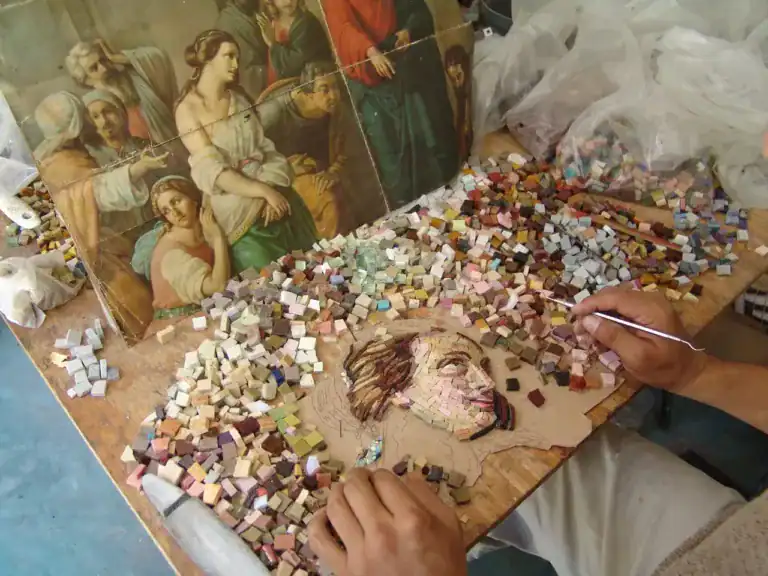
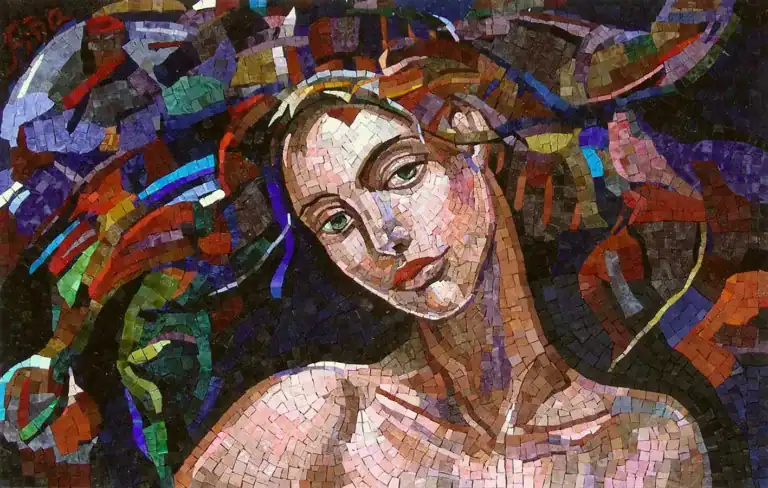
Byzantine mosaic art is the foundation of everything we do at Mosaiclegs Art Studio. The techniques, materials, and design vocabulary of Byzantine mosaic art — opus vermiculatum figure outlining, hand-cut smalti glass, gold leaf tesserae, directional tile-laying — have been in continuous use for over 1,500 years, and they remain the benchmark for quality in mosaic work today.
Authentic Byzantine mosaic art is defined by several technical characteristics that separate it from modern machine-cut tile work. Tesserae in true Byzantine mosaic art are cut by hand using a hammer and hardie, creating slightly irregular edges that catch light at different angles. The laying technique follows the contour of each figure — a method called opus vermiculatum — giving Byzantine mosaic art its characteristic sense of depth and movement. Gold and silver leaf glass tesserae, applied at slight angles, create the shimmering gold grounds seen in historic Byzantine church interiors. Learn more about this tradition at the Metropolitan Museum of Art.
We apply Byzantine mosaic art techniques to contemporary commissions — luxury pool interiors, architectural murals, religious installations, and fine art reproductions. Our use of Byzantine mosaic art methods means every project we produce is a permanent, museum-quality installation, not a decorative tile application. View our religious mosaic artwork, our Knossos recreation, and our full portfolio. Contact us to discuss your commission.