Can Smalti Be Used for Exterior Mosaics?
Yes — and it is one of the few mosaic materials with a thousand years of outdoor evidence behind it. Smalti has survived on building exteriors since the Byzantine era, through freeze-thaw cycles, salt air and direct sun, with its color intact.
But the honest answer has a second half: exterior mosaics do fail, and when they do it is almost never the smalti. It is what sits behind it. Understanding that difference is the whole of specifying this material well.
What smalti actually is
Smalti is an opaque glass made by fusing silica, metal oxides and minerals in small furnaces at very high temperature. The molten glass is hand-poured into flat cakes and left to cool slowly, then broken down and hand-cut into irregular tesserae with a hammer and hardie.
The smalti we work in is Mexican, made by the descendants of Italian glassmakers who emigrated to Mexico around 1949. It is not an imitation of the Venetian material — it is the same craft, carried across the Atlantic by the people who practiced it and kept in small furnaces ever since. The tradition is unbroken; only the address changed.
Two materials, and the difference matters when you specify. Smalti — Byzantine glass — is the hand-poured, hand-cut irregular tesserae described above. It runs to over 1,000 colors, it is noticeably thicker, and it is more expensive both to make and to work with. It is also a pleasure to work with, and it is what a piece gets when it needs fine detail and a wide color range: a face, a gradient, a figure. Smalto — Venetian glass — is the other. It reaches us as uniform squares, typically 3/4″ or 1″, which we break down into smaller pieces as the artwork requires. The majority of our projects are built in smalto. Both are the same family of enameled glass, so everything above about fade, water and chemical resistance applies equally to each. Where they differ is body: smalti is thicker, and that makes it physically stronger — more tolerant of impact and abrasion, and simply more substantial in the hand. It is a better material, and that is a large part of why it costs more. Neither will fail outdoors from weathering. But where a surface will take knocks — a step, a bench, a bond beam edge, anything at ground level — the extra thickness of smalti is worth paying for. You can see both side by side on our glass tile and smalti page — the even squares are smalto, the irregular hand-cut pieces are smalti.
The color is not on the glass. It is in the glass. Metal oxides are fused into the molten batch — cobalt for blue, copper and iron for greens, gold and selenium for reds. There is no glaze, no coating, no printed surface layer. That single fact is why smalti behaves the way it does outdoors.
Why it survives outside
It cannot fade. Pigment fused into glass has nowhere to go. Ultraviolet light degrades organic pigments and surface glazes; it does nothing to a metal oxide suspended in silica. A smalto that is cobalt blue today will be cobalt blue in a century.
It does not absorb water. Smalti is effectively non-porous. Freeze-thaw damage happens when water gets into a material, expands as it freezes and breaks it apart from within. Water cannot get into smalti, so there is nothing to expand. This is why it performs in climates that destroy unglazed ceramic and natural stone.
It is chemically inert. Glass does not care about chlorine, salt water, pool chemistry or acid rain.
And the surface is the point. Smalti is cut, not molded, so every tessera has a slightly irregular face and tiny trapped bubbles from the pour. Set at subtly varying angles, those faces catch light from several directions at once. Outdoors, where the light moves all day, that is the whole reason to use the material.
The thousand-year evidence
Giorgio Vasari, the sixteenth-century Italian painter and art historian, put it better than anyone since: “Mosaic is the most durable picture that exists. Other painting fades through time, but mosaic continually brightens with age.” He was writing about the material five hundred years ago, and the record has held.
The mosaics of Ravenna have been in place since the fifth and sixth centuries. The facade mosaics of St. Mark’s in Venice have faced the Adriatic for generations. These are not laboratory tests. They are smalti, outdoors, in a marine climate, still holding color.
No modern material has that record, for the simple reason that no modern material has been outside long enough to prove it.
So what actually fails?
When an exterior or submerged mosaic fails, the failure is almost always in one of three places — and the glass is not one of them.
1. The setting bed. Water that gets behind the tesserae and freezes will lift them off. This is a mortar, substrate and waterproofing problem. Smalti’s own imperviousness makes it worse if the assembly is wrong, because water that gets behind it cannot escape through it either.
2. Movement. Buildings and pool shells move — thermally, structurally, as they cure. A rigid mosaic bonded across a moving joint will crack along that joint. Expansion and control joints have to be carried through the mosaic, not bridged by it.
3. The mounting method. The one most often overlooked, and it matters more underwater than anywhere else.
Mesh-mounted versus paper-faced — the specification that matters
Most mosaic sold today arrives mesh-mounted: the tesserae are glued face-up to a fiberglass mesh backing, and the whole sheet is pressed into thinset.
The mesh stays in the assembly forever. It sits between the back of every tessera and the mortar that is supposed to hold it, along with the adhesive that bonds it. That reduces actual mortar-to-glass contact area, and in permanently wet service some mounting adhesives soften over time.
Paper-faced mounting is the opposite. The tesserae are mounted face-down to paper. The sheet is set into the mortar, and once it has taken up the paper is wetted and peeled away. Nothing is left in the assembly. Every tessera has full, direct contact with the setting bed, and the back of the glass — with its irregular cut face — keys into the mortar.
For a submerged or exterior installation meant to last decades, that difference is not cosmetic. It is why we mount paper-faced and do not use mesh, and why every commission leaves the studio in numbered sections to a keyed layout rather than as sheets.
Smalti in pools: where it belongs
Smalti can be used in pools, and on indoor floors. It is not ruled out, and we have done both. But on floors we normally work in medallions — a defined piece of artwork set into a plaster or all-tile field, rather than a whole floor surfaced in hand-cut smalti. There is a reason for that, and it comes from what we have seen over time rather than from theory.
On walls, there is no such limit. A spa wall, a raised bond beam, a waterline band, a feature wall, a fountain or any vertical exterior surface can carry a full mosaic artwork in smalti, at whatever scale the architecture allows. Vertical surfaces are not walked on, so the riven, hand-cut face that gives smalti its character costs nothing in use.
Gold smalti is more delicate than color smalti. Genuine 24k gold smalti is gold leaf sandwiched between a backing glass and a thin protective cap of clear glass. Submerged and on vertical surfaces it lasts indefinitely. In a high-abrasion underfoot position it deserves more thought.
What we have actually seen go wrong. Over long periods, in pools and on floors, the failure we have observed is small pieces coming loose. Not fading, not clouding, not the glass breaking down — the material itself is fine decades later. It is the smallest tesserae letting go.
The reason is bond area. A small piece has less back surface holding it, and it is doing the same work as a large one — taking foot traffic, thermal movement and, in a pool, constant immersion. The smaller the piece and the harder the surface is worked, the more everything behind it has to be right.
Which is the whole argument of this page, arriving from the other direction: installation and adhesion are the thing. And the proof is not ours — it is archaeological. Mosaics are unearthed intact after being buried for two thousand years, tesserae still held in their original bed, the color unchanged. Glass does not lose color. It can get dirty — scale, calcium, the ordinary grime any surface collects — but that is on top of it, not in it. Clean it and the brilliance is exactly what it was. Nothing about the glass has given up in twenty centuries. Where a mosaic has failed, it is because the bed failed, and where it has survived being buried and dug out again, it is because the bed held. That is as complete a long-term test as any building material has ever been given.
A third option: framed, and shipped as a finished artwork
Not every mosaic has to be set into a building at all.
A mosaic can be built onto a rigid backing, framed, and shipped as a finished piece of art — hung on a wall like a painting, with no tile setter, no thinset and no site work.
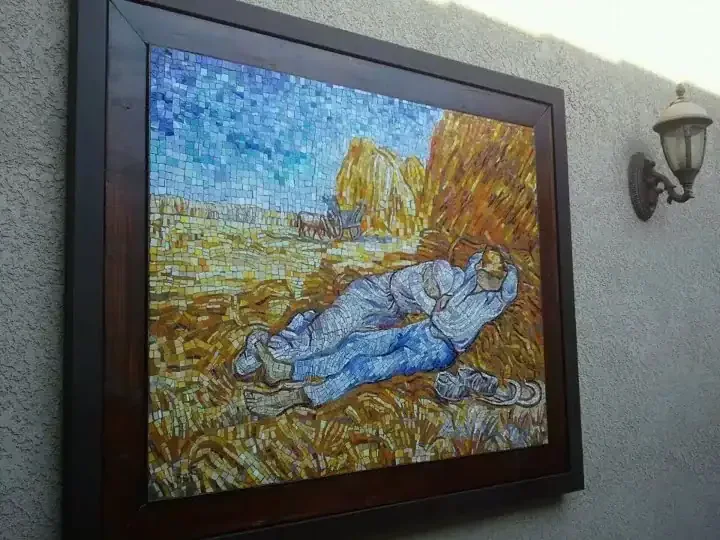
We have done this. The Van Gogh mosaic — Afternoon Rest (after Millet) was built and delivered this way.
The substrate is cement board. The mosaic is set onto a piece of cement board cut to size, which is the right backing for the job: dimensionally stable, unaffected by moisture, and it takes thinset the same way a wall does. It will not warp, rot or move with humidity the way a timber panel can — which matters when the piece is going to outlive the room it hangs in.
The frame on the Van Gogh piece was made by Studio Steel in Riverside, California. A steel surround suits the weight and keeps the edge crisp, and having it made locally means the frame can be built to the finished mosaic rather than the mosaic squeezed into a stock frame.
The honest constraint is freight, not fabrication. A framed mosaic is heavy, rigid and fragile in exactly the way carriers charge for. Crating and shipping a large framed piece can become a serious line item — sometimes enough to change the decision. It is worth pricing freight early rather than at the end, and for larger work, paper-faced sections shipped flat to a local setter are usually the more economical route.
The steel frame for the Van Gogh mosaic, made by Studio Steel of Riverside, California.
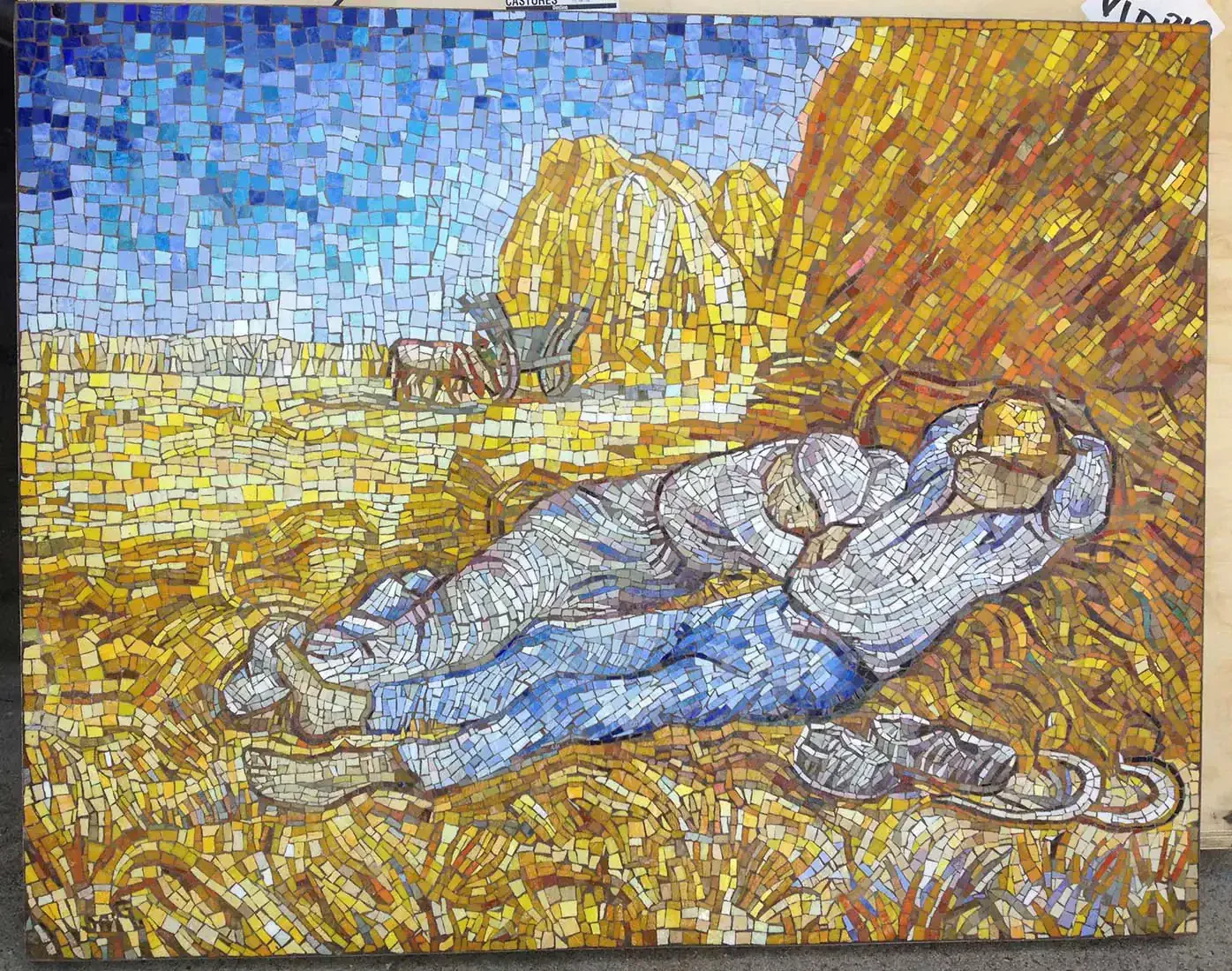
The finished piece — Afternoon Rest (after Millet), framed and ready to ship.
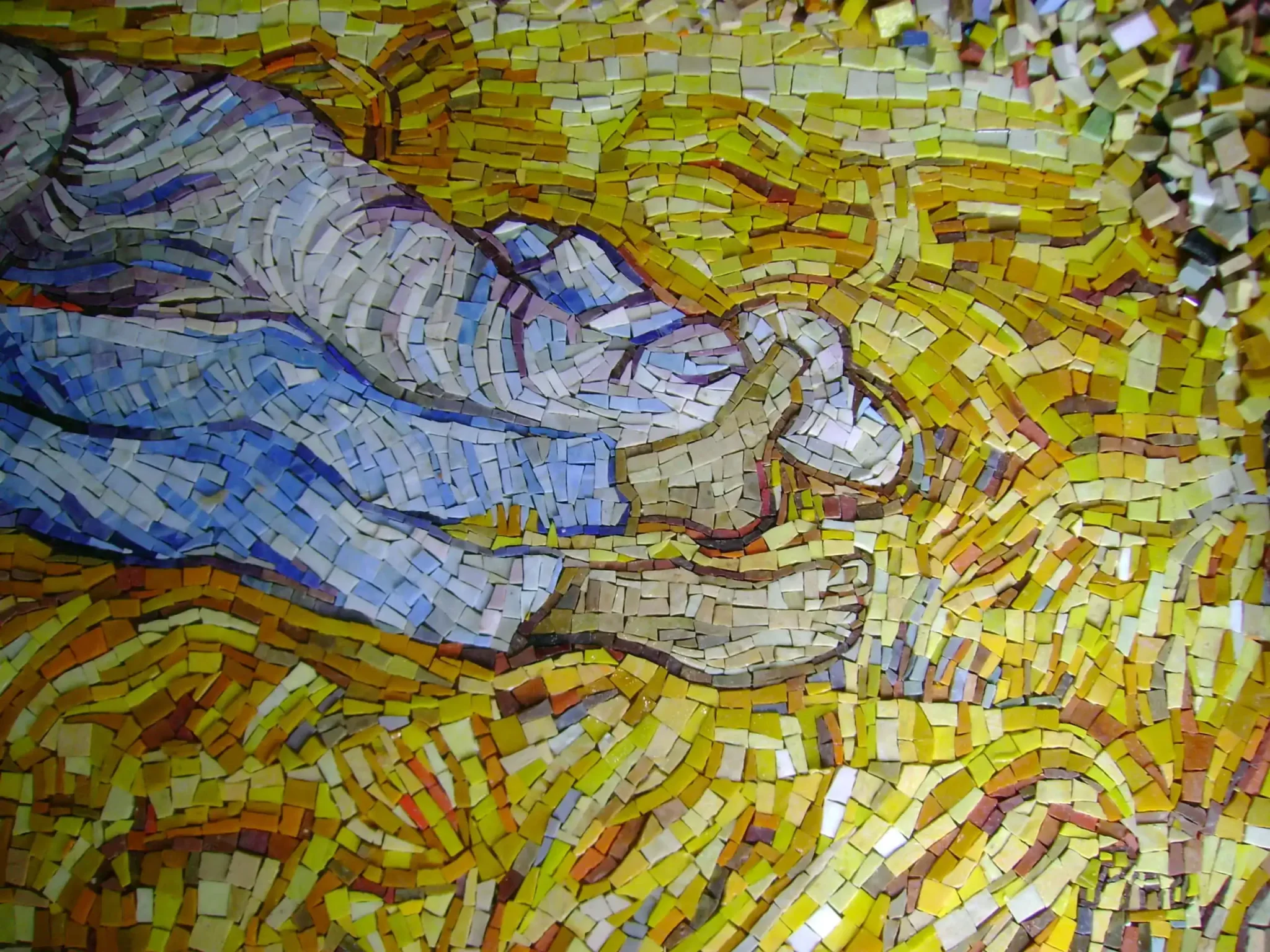
Detail: hand-cut tesserae at the foot of the figure.
Which material, where
Glass is not the answer to everything, and it is worth being plain about that.
Marble — outdoor spaces, walkways and high-traffic paving. Where people walk on a surface all day, in shoes, outdoors, stone is the right material. It takes that wear in a way glass is not asked to. This is the one place we would steer you away from a glass mosaic entirely.
Smalto (Venetian glass) — pools. Waterline, walls, spa surfaces and the body of the work. It is what the majority of our pool commissions are built in.
Smalti and smalto together — indoor art and backsplashes. Interior work is where the two are most freely mixed: smalti for the detail and color range, smalto for the field around it.
A pool floor medallion sits across two of these — a smalti medallion set into a plaster or all-tile floor, rather than a floor surfaced in smalti. That is the normal shape of the work.
Specifying an exterior smalti mosaic
If you are an architect, designer or pool builder writing this into a set:
Substrate: sound, clean, dimensionally stable, correctly waterproofed for submerged work. The mosaic is a finish, not a waterproofing layer.
Mortar: a polymer-modified thinset appropriate to the substrate and to permanent immersion. Follow the manufacturer’s specification for glass mosaic — glass bonds differently from ceramic.
Movement joints: carried through the mosaic surface, not bridged.
Mounting: paper-faced, in numbered sections to a keyed layout, so the setter installs to a drawing rather than improvising.
Grout: appropriate to joint width and to immersion.
Setting is a tile setter’s trade, and a good one is worth finding. We fabricate; your setter installs. Every commission arrives paper-faced in numbered sections with a keyed layout, so the work on site is placement rather than interpretation.
The short version
Smalti is one of the most durable decorative surfaces available for exterior and submerged use. It cannot fade, it does not absorb water, and it is chemically inert. Its record outdoors is measured in centuries.
The material will outlast the building it is set into. Whether the installation does depends on the substrate, the mortar, the movement joints and the mounting method — not on the glass.
Mosaiclegs Art Studio has designed and fabricated hand-cut mosaic artwork since 1998, including the 38 ft × 6 ft 6 in. mural at San Diego International Airport. We fabricate and ship; your tile setter installs.
Begin your commission
Send the details of your project, or call (323) 389-5347. Studio hours are Monday to Friday, 9am to 5pm, and Saturday, 9am to 1pm, Pacific.